
AI & Data Analytics for Finance Professionals | Simandhar
See how AI, data analytics and cybersecurity awareness help finance professionals become strategic advisers. Explore Simandhar’s CAAP course.
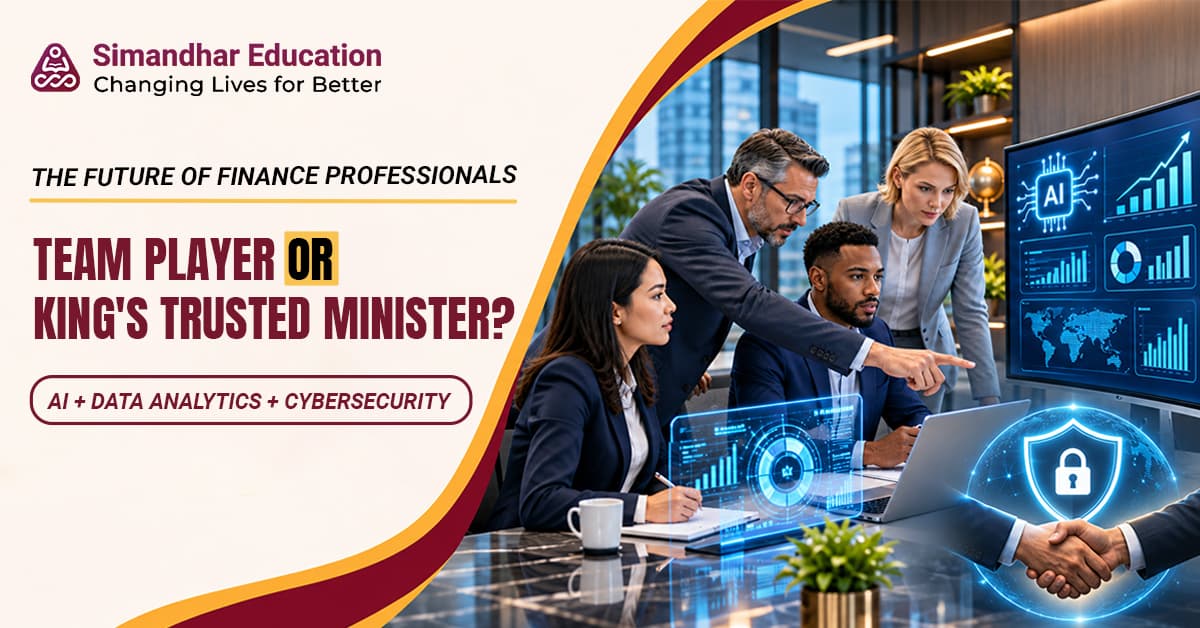
Table of Contents
- 1. Are You Just a Finance Team Player—or the King’s Trusted Adviser?
- 2. A Tuesday Morning in the Finance Team
- 3. Why the Finance Role Is Expanding
- 4. Five Skills That Work Together
- 5. Back to Tuesday Morning
- 6. Building These Skills Step by Step with CAAP
- 6.1. Level 1 - the Foundation
- 6.2. Level 2 - Advanced Applications
- 7. The Takeaway
- 8. Frequently Asked Questions
Are You Just a Finance Team Player—or the King’s Trusted Adviser?
How AI, Data Analytics and Cybersecurity Awareness Help Finance Professionals Become Strategic Business Advisers
A Tuesday Morning in the Finance Team
It is month-end close. Your team is moving fast: reconciliations are done, the numbers tie out, and the management report is nearly ready. Then three things land at the same hour.
A vendor emails to say its bank details have changed and asks you to update them before today’s payment run. A routine analysis throws up two invoices with the same amount, the same vendor, and dates three days apart. And a department head asks why the cloud-services line is well above budget, and whether it will keep climbing.
A strong team member will process, reconcile, and report. All of those matters, and none of them is wrong. But a trusted adviser also pauses to ask a few more questions. Is the bank-detail change genuine? Is that second invoice a duplicate? Is the overspend a one-off or a pattern that will hit next quarter’s forecast?
That gap between reporting what happened and helping leadership see what could happen next is where finance professionals grow. And it is a team effort. The AP executive who spots the duplicate, the analyst who explains the variance and the controller who escalates the payment request all contribute to the same outcome: a business that decides with confidence.
Why the Finance Role Is Expanding
In the old picture, finance recorded the past. Today, leadership expects finance to also read the signals in the data, flag risk early, and recommend a next step. Think of the “King’s Trusted Adviser” as the colleague a leader turns to when a decision is on the table, because that person explains the numbers clearly, points out the risks and suggests what to do.
Three current trends make this shift practical rather than theoretical.
- Skills are changing across industries: The World Economic Forum’s Skills Outlook in its Future of Jobs Report 2025 highlights technology-related skills, including AI and big data, networks and cybersecurity and technological literacy, among the fastest-growing skill areas, alongside analytical thinking.
- Payment fraud targets finance teams directly: The FBI describes Business Email Compromise (BEC) as a scam aimed at businesses that regularly make payments, often involving spoofed emails and requests to change payment details. Its 2025 IC3 Annual Report tracks the reported losses from such crimes. The people who release payments and update vendor records sit on the front line.
- AI is now part of everyday finance work: Drafting commentary, building Excel formulas and summarizing variances are all easier with AI. The professional’s job shifts toward framing the right question, checking the output, and protecting confidential data.
None of these replaces accounting knowledge. It builds on it, and it works best when the whole team shares these habits.
Five Skills That Work Together
No single skill makes a trusted adviser. The strength comes from how these five combine, and from how a team shares them.
- Financial knowledge: does the transaction make business sense? Accounting training teaches you to judge whether an entry, a contract, or a cost pattern is reasonable. This is the foundation everything else rests on.
- Data analytics: what is the data telling us? Analytics helps you flag duplicate invoices, unusual payment patterns, or unexpected variances for review. Tools such as Excel, Power BI, and Tableau let you test every transaction rather than a small sample.
- Cybersecurity awareness: is this request genuine? Recognize suspicious requests, verify bank-detail changes through known contact, and follow secure data-sharing practices. Finance holds payment authority and sensitive data, so careful habits here protect the whole organization.
- AI literacy: how do we use AI responsibly? Use AI to assist with analysis and reporting, then check its outputs against source data and protect confidential information. AI speeds up the work. You remain accountable for the answer.
- Business communication: what should leadership do next? Explain the risk in plain language and recommend the next step. A finding only changes a decision when someone can understand it quickly.
Back to Tuesday Morning
With these skills, the same three moments look different. The bank-detail request is verified through a number already on file before any payment moves. An analytics check confirms the duplicate invoice and holds it for review. An AI-assisted variance analysis, double-checked by the analyst, shows the cloud overspend comes from one team’s usage growth, so the note to the department head recommends a usage review before the next forecast.
Notice how many people are involved: AP, analytics, the controller, and the business owner. Becoming a trusted adviser does not mean working alone. It means making your team’s work more visible and more useful to leadership.
Building These Skills Step by Step with CAAP
If this sounds like a lot to learn at once, a structured pathway helps. Simandhar’s Certified AI Accounting Professional (CAAP) programme is designed for finance and accounting professionals who want practical AI and analytics skills that connect to real finance work. It moves in two levels.
Level 1 - the Foundation
AI for finance and accounting, large language models (LLMs) and prompt engineering, and AI-enabled Excel. You learn to use AI tools with confidence in everyday tasks such as reporting, reconciliation support, and analysis.
Level 2 - Advanced Applications
Tableau, exploratory data analysis, anomaly detection, forecasting, risk management, machine learning, and AI agents. This is where you go from checking data to spotting irregularities, projecting what may come next, and presenting it for decisions.
The two levels map neatly to the shift described in this article. Level 1 helps you work faster and more accurately. Level 2 helps you move from describing the past to anticipating what could happen next, which is the question a trusted adviser keeps asking. Whether you are an accounting graduate, a working accountant or a finance professional looking to grow, CAAP lets you build skills in sequence while applying them to the work your team already does.
The Takeaway
Next time a report is ready to go, ask yourself: Am I only reporting what happened, or am I also helping leadership understand what could happen next?
You do not need to leave your team’s side to answer that. The strongest finance teams grow together: one person sharpens the analytics; another keeps the payment controls tight; another translates findings into plain recommendations. Each of them is building the same reputation as the whole team.
Become the finance professional leadership turns for clearer insights, stronger judgement and better-informed decisions.
Ready to start? Explore Simandhar’s CAAP programme to build practical AI and analytics skills for finance.
Frequently Asked Questions
1 Why is financial knowledge alone becoming insufficient for some finance roles?
Financial knowledge remains the foundation, but many roles now involve large data sets, AI tools and digital payment risks. Professionals who can combine accounting judgement with analytics, security awareness, and clear communication are better placed to support leadership decisions.
2 How can data analytics help finance teams identify potential risks?
Analytics can scan complete transaction sets to flag duplicate invoices, unusual payment patterns, and unexpected variances. The team then reviews these flags and applies business judgement. This turns risk-spotting from an occasional sample check into a regular, evidence-based habit.
3 What cybersecurity practices should finance professionals understand?
Start with the basics: treat unexpected payment or bank-detail change requests with caution, verify them through a known contact before acting, and share financial data only through approved, secure channels. Report anything suspicious to your team and IT early.
4 How can accountants use AI responsibly?
Use AI to assist with analysis, drafting, and reporting, but always check its outputs against source records. Avoid entering confidential client or company data into tools your organization has not approved and follow your firm’s data protection policies.
5 What is included in Simandhar’s CAAP Level 1?
Level 1 covers AI for finance and accounting, large language models (LLMs) and prompt engineering, and AI-enabled Excel. It builds the foundation for advanced applications covered in Level 2.
6 How can a finance professional become a trusted adviser to leadership?
Build your financial knowledge, add data analytics, cybersecurity awareness and AI literacy, and practice explaining risks and recommending next steps in plain language. Collaborate with colleagues across finance and the business, because trust grows through consistent, shared work.