
CA Foundation Fail to CPA Success Story
Read how a student who failed CA Foundation four times successfully cleared CPA through conceptual learning, Becker practice, and Simandhar Education mentorship.
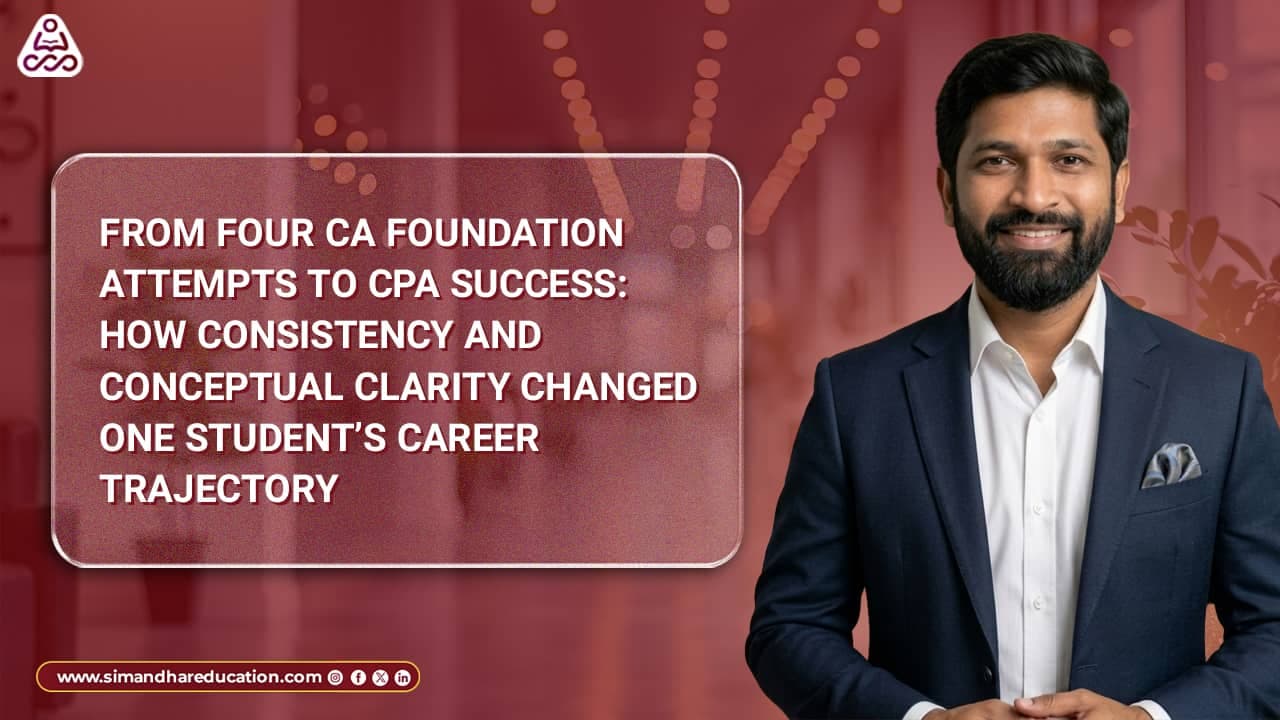
Table of Contents
- 1. From Four CA Foundation Attempts to CPA Success: How Consistency and Conceptual Clarity Changed One Student’s Career Trajectory
- 2. Why He Chose CPA Instead of an MBA or Other Qualifications
- 3. Discovering Simandhar Education Through LinkedIn and YouTube
- 4. The Reality Behind His CPA Journey: Failure Before Progress
- 5. The Critical Shift: Understanding What “85 Scores” Actually Mean
- 6. Managing CPA Preparation Alongside Work
- 7. How Simandhar Education and Becker Helped Him
- 8. From CA Foundation Failures to CPA Qualification
- 9. What Future CPA Aspirants Can Learn From His Journey
- 10. Why Simandhar Education Continues to Stand Out for CPA Aspirants
- 11. Final Thoughts
From Four CA Foundation Attempts to CPA Success: How Consistency and Conceptual Clarity Changed One Student’s Career Trajectory
For many commerce students in India, professional education is not merely about passing examinations. It is often tied to identity, confidence, career mobility, and the ability to create opportunities beyond one’s immediate environment. Yet, the journey is rarely linear.
This is the story of a student from a small town nearly 500 kilometers away from Bangalore, who once struggled to clear the CA Foundation examination despite four attempts, but eventually went on to complete the CPA qualification through disciplined preparation, conceptual learning, and the right mentorship ecosystem.
His journey reflects an important truth about modern professional education: success is no longer reserved only for academically “perfect” students. It belongs to students who build consistency, clarity, and resilience over time.
Why He Chose CPA Instead of an MBA or Other Qualifications
While evaluating career options, the student strongly believed that today’s competitive accounting and finance market requires globally relevant professional certifications rather than generic qualifications alone.
According to him, certifications such as CPA, CA, ACCA, and similar professional credentials provide stronger positioning for leadership opportunities and long-term career competitiveness.
However, what influenced his final decision toward CPA was not marketing hype or social pressure. It was the practical guidance he consistently observed through Sripal Jain’s conversations with successful CPA candidates.
He explained that while exploring different programs and institutions, he regularly watched Sripal Sir’s videos, student interviews, and educational discussions. What stood out to him was the honesty of the messaging.
Rather than promising shortcuts, Sripal Sir repeatedly emphasized one core principle:
“If you want to clear CPA, you have to do hard work. There is no shortcut. But hard work does not mean studying 24 hours a day. Consistency is what matters.”
This realistic and disciplined approach helped him develop the mindset required to commit fully to the CPA journey.
Discovering Simandhar Education Through LinkedIn and YouTube
Interestingly, his introduction to Simandhar Education happened organically through LinkedIn and YouTube.
He began noticing LinkedIn posts from CPA-qualified professionals and students associated with Simandhar Education . Simultaneously, YouTube started recommending Sripal Sir’s interviews and discussions with successful candidates.
Over time, these interactions created trust and credibility.
Unlike traditional promotional content, he felt the conversations focused more on preparation discipline, exam strategy, and long-term career transformation rather than superficial marketing narratives.
That distinction played a significant role in his enrollment decision.
The Reality Behind His CPA Journey: Failure Before Progress
One of the most important aspects of his story is its honesty.
His CPA journey was not instantly successful.
In fact, he openly shared that the first section took nearly two years, including one failed paper where he could not secure a passing score.
The biggest challenge for him was the AUD (Auditing) section.
Coming from a modest educational background and basic conceptual exposure, he initially struggled to understand the auditing framework and exam application style.
He admitted that during the early phase of preparation, his approach relied heavily on memorization rather than conceptual understanding.
That strategy failed.
The turning point came when he realized that CPA examinations are fundamentally concept-driven rather than memory-driven.
Once he shifted from rote preparation to deep conceptual learning, everything began to change.
The Critical Shift: Understanding What “85 Scores” Actually Mean
One of the most powerful insights from his interview revolved around a common misunderstanding among CPA aspirants.
He recalled how Simandhar counselors and mentors repeatedly advised students to consistently score above 85 in Becker practice tests before appearing for the actual examination.
Initially, he misunderstood this recommendation.
He believed scoring 85 simply meant repeating questions enough times until answers were memorized.
However, after facing setbacks, he realized something crucial:
“The 85 score is not about mugging up answers. It is about understanding concepts thoroughly.”
This realization completely transformed his preparation strategy.
Instead of attempting to memorize patterns, he focused on:
● Conceptual clarity
● Understanding application logic
● Analyzing simulations properly
● Practicing MCQs with reasoning
● Strengthening weak areas consistently
That conceptual foundation ultimately helped him clear subsequent papers much more efficiently.
Managing CPA Preparation Alongside Work
Like many working professionals pursuing CPA, balancing preparation with employment responsibilities was another major challenge.
His study structure was disciplined but realistic.
He followed:
● 2–3 hours of study during weekdays
● 5–6 hours during weekends
● Continuous daily consistency instead of extreme study schedules
Importantly, he emphasized that consistency matters more than temporary bursts of motivation.
According to him, even difficult subjects become manageable when students maintain disciplined preparation over long periods.
How Simandhar Education and Becker Helped Him
Throughout the interview, he repeatedly acknowledged the role of Simandhar Education and Becker in shaping his success.
He specifically appreciated:
● Structured mentorship
● Concept-based guidance
● Clarity around exam strategy
● Availability of support teams
● Becker simulations and practice systems
● Continuous motivation through student success interactions
His statement summarizing the experience was particularly powerful:
“If I have the combo of Simandhar and Becker, I think I will be able to pass.”
For students who come from non-elite academic backgrounds or smaller towns, this statement carries significant meaning. It reinforces that with the right ecosystem, disciplined preparation can overcome educational disadvantages.
From CA Foundation Failures to CPA Qualification
Perhaps the most inspiring aspect of his journey is the contrast between his starting point and final achievement.
He openly revealed that he had previously attempted the CA Foundation examination four times without success.
At one stage, he genuinely doubted his academic capability.
Yet within two years, he successfully progressed through the CPA pathway.
This transformation highlights an important professional reality:
different qualifications suit different learning styles, career aspirations, and preparation approaches.
His success demonstrates that past academic setbacks do not define future professional outcomes.
What Future CPA Aspirants Can Learn From His Journey
His experience offers several important lessons for students considering CPA:
1. Consistency Is More Important Than Intensity
Studying a few hours daily with discipline is more sustainable than inconsistent marathon sessions.
2. CPA Is a Conceptual Exam
Memorization alone is insufficient. Understanding application logic is essential.
3. Guidance Matters
The right mentorship ecosystem can significantly reduce confusion and improve preparation efficiency.
4. Failure Is Not Final
Academic setbacks in one qualification do not determine long-term career success.
5. Small-Town Students Can Compete Globally
Professional qualifications like CPA create opportunities that extend beyond geographic limitations.
Why Simandhar Education Continues to Stand Out for CPA Aspirants
Simandhar Education has built strong credibility among CPA aspirants because of its practical preparation ecosystem, experienced mentorship, structured guiadance, and strong student-focused approach.
What differentiates the institution is not simply course delivery, but the emphasis on:
● Conceptual clarity
● Realistic preparation expectations
● Student mentorship
● Career-focused guidance
● Consistency-driven learning models
For many students, especially working professionals and aspirants from non-traditional academic backgrounds, this support structure becomes a major competitive advantage.
Final Thoughts
Professional success stories are often presented as smooth journeys filled with uninterrupted achievements.
This story is different.
It is a story of repeated setbacks, self-doubt, conceptual struggles, gradual improvement, and eventual transformation.
From failing CA Foundation multiple times to completing CPA through disciplined preparation, this student’s journey demonstrates that persistence combined with the right mentorship can fundamentally alter career trajectories.
And perhaps the most important takeaway from his experience is this:
Success in professional education is rarely about brilliance alone.
Planning to take CPA? Explore our CPA course