
EA Eligibility for BBA Graduates: The Complete Guide
Can BBA graduates pursue the EA course? Explore EA eligibility for BBA graduates, exam structure, duration, career opportunities, and jobs in US taxation in India.
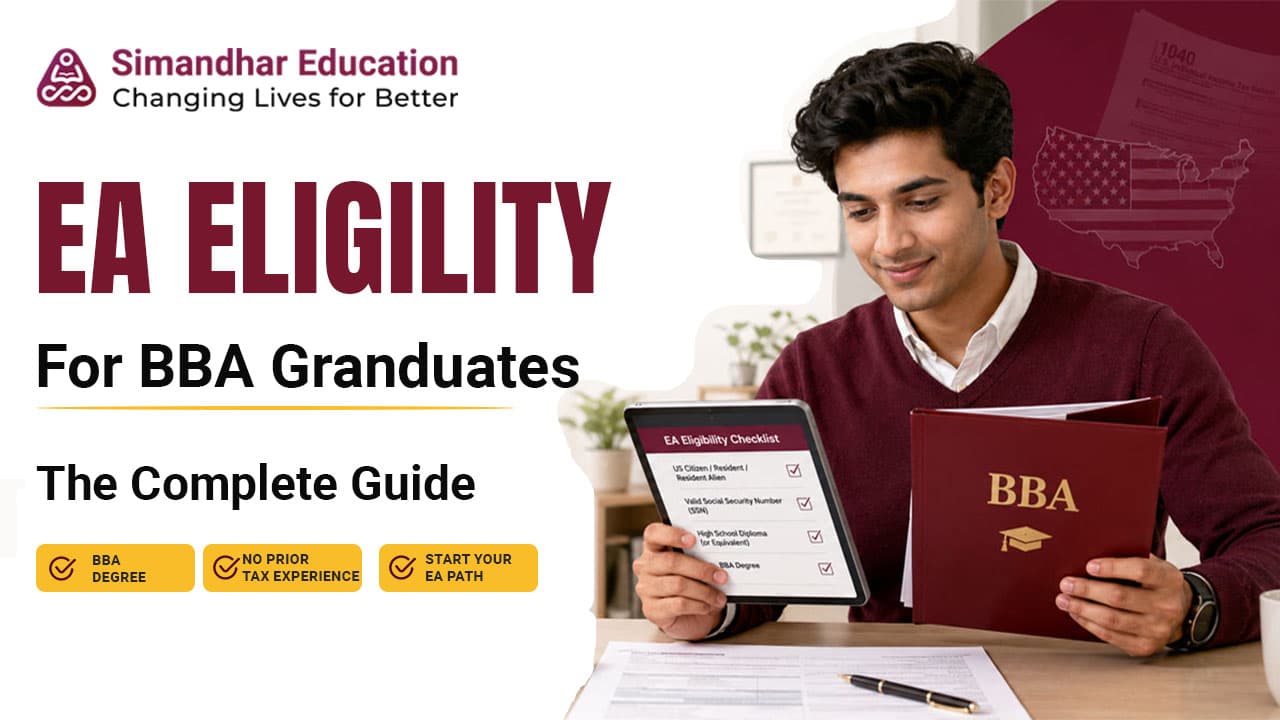
Table of Contents
- 1. EA Eligibility for BBA Graduates: The Complete Guide
- 2. What Is an Enrolled Agent?
- 3. Can BBA Graduates Pursue EA?
- 4. What Are the Eligibility Requirements for EA After BBA?
- 5. How Many Exams Are There in EA After BBA?
- 5.1. Part 1: Individuals
- 5.2. Part 2: Businesses
- 5.3. Part 3: Representation, Practices and Procedures
- 6. EA Course Duration After BBA
- 7. Why Is EA a Good US Taxation Course for BBA Graduates?
- 8. EA for Commerce and BBA Students
- 9. Jobs After BBA and EA Certification
- 10. Skills BBA Graduates Should Develop Alongside EA
- 11. How Simandhar Education Helps BBA Graduates Pursue EA
- 12. Final Thoughts
- 13. Frequently Asked Questions
- 13.1. Can BBA graduates pursue EA?
- 13.2. Can I do EA after BBA in India?
- 13.3. What are the eligibility requirements for EA after BBA?
- 13.4. How many exams are there in EA after BBA?
- 13.5. What is the EA course duration after BBA?
- 13.6. Is EA suitable for BBA students without a taxation background?
- 13.7. What jobs can I get after BBA and EA certification?
- 13.8. Is EA a good US taxation course for BBA students in India?
- 13.9. Can I pursue EA while completing my BBA?
- 13.10. Does EA guarantee a job after BBA?
EA Eligibility for BBA Graduates: The Complete Guide
If you have completed a Bachelor of Business Administration (BBA) and are exploring career options beyond a traditional MBA or general finance role, the Enrolled Agent (EA) qualification is worth considering—especially if you are interested in taxation, accounting, compliance, or working with US-focused organizations.
One of the first questions students usually ask is: Can BBA graduates pursue EA?
Yes. BBA graduates can pursue the Enrolled Agent qualification. The EA pathway does not require candidates to hold a specific accounting degree, making it accessible to graduates from different educational backgrounds.
For BBA graduates, the combination of business knowledge and US taxation expertise can create opportunities in accounting firms, tax service companies, shared service centers, and organizations serving US clients.
Here is a complete guide to EA eligibility for BBA graduates, the exam structure, course duration, and career opportunities.
What Is an Enrolled Agent?
An Enrolled Agent is a federally authorized tax practitioner who is empowered by the US Department of the Treasury to represent taxpayers before the Internal Revenue Service (IRS).
Unlike many finance qualifications that cover multiple areas of accounting and business, EA is highly focused on US federal taxation.
EA professionals can develop expertise in areas such as:
- Individual taxation
- Business taxation
- Tax compliance
- Tax preparation
- IRS procedures
- Representation before the IRS
This specialization is one reason the EA course for BBA graduates can be attractive to students who want to enter the US taxation domain.
Can BBA Graduates Pursue EA?
Yes, BBA graduates can pursue EA.
You do not need to complete a B.Com, M.Com, MBA, CA, CPA, or another professional accounting qualification before beginning the EA journey.
This makes the EA course suitable for graduates who want to build specialized knowledge without spending several additional years completing another degree.
For students asking, “Can I do EA after BBA?”, the straightforward answer is yes. Your BBA background can also help because you may already be familiar with subjects such as accounting, finance, economics, business law, and management.
However, you will still need to build a strong understanding of US taxation concepts to prepare effectively for the EA exams.
What Are the Eligibility Requirements for EA After BBA?
One of the biggest advantages of the Enrolled Agent pathway is that there is no specific educational degree requirement for taking the Special Enrollment Examination (SEE).
Therefore, EA eligibility for BBA students in India is relatively straightforward.
A BBA graduate does not need a specific number of accounting credits or a postgraduate qualification simply to take the EA exams.
Candidates generally pursue EA status through the following process:
- Obtain the required identification to register for the exam.
- Pass all three parts of the Special Enrollment Examination.
- Apply for enrollment with the IRS.
- Complete the IRS suitability check and other applicable requirements.
Indian candidates should carefully follow the current IRS and exam administrator procedures when registering because identification and application requirements can change.
How Many Exams Are There in EA After BBA?
The EA exam, officially known as the Special Enrollment Examination (SEE), consists of three parts:
Part 1: Individuals
This section focuses primarily on US taxation for individuals. Candidates study areas such as income, deductions, credits, property transactions, retirement plans, and individual tax returns.
Part 2: Businesses
This part focuses on the taxation of different business entities and related tax concepts. It can include corporations, partnerships, estates, trusts, business income, deductions, and other federal tax topics.
Part 3: Representation, Practices and Procedures
The third part focuses on IRS practices, procedures, professional responsibilities, representation, and the rules governing tax practitioners.
You do not necessarily have to take all three parts together. Candidates can prepare for and schedule the sections separately, subject to the applicable testing rules.
EA Course Duration After BBA
There is no single fixed EA course duration after BBA because preparation time depends on your study schedule, familiarity with taxation, and coaching approach.
Many candidates aim to prepare for all three EA exam parts within approximately 6–12 months. Some may finish sooner, while working professionals or students balancing other commitments may take longer.
Your BBA background can provide a useful foundation, but US taxation is likely to be a new subject for most Indian graduates. It is therefore important to focus on understanding concepts rather than simply memorizing tax rules.
A structured study plan, regular question practice, revision, and mock exams can make preparation more manageable.
Why Is EA a Good US Taxation Course for BBA Graduates?
BBA is a broad business degree. It introduces students to multiple areas, but many graduates later look for a specialization that can differentiate their profile.
This is where a US taxation course for BBA graduates such as EA can be valuable.
EA allows you to move from general business education toward a specific professional domain. Instead of competing only for broad entry-level business roles, you can develop expertise relevant to organizations handling US taxation and compliance work.
For students interested specifically in taxation, EA certification after BBA can provide a more focused career direction.
EA for Commerce and BBA Students
Although B.Com students may have more extensive academic exposure to accounting and taxation, BBA students should not assume that EA is only for accounting graduates.
The qualification can be pursued by students from different academic backgrounds.
For a BBA graduate, subjects such as business law, financial management, accounting fundamentals, economics, and organizational studies may provide useful context while studying US tax concepts.
What matters more is your willingness to learn the US tax system systematically.
Therefore, when comparing EA for commerce students with EA for BBA graduates, the key difference may be the starting level of accounting knowledge—not eligibility itself.
Jobs After BBA and EA Certification
The combination of BBA and EA can help candidates explore specialized opportunities related to US taxation.
Potential Enrolled Agent jobs in India and related roles may include:
- US Tax Associate
- Tax Analyst
- US Tax Consultant
- Tax Preparer
- Tax Compliance Associate
- Tax Senior, with relevant experience
- US Individual Taxation Associate
- US Business Taxation Associate
- Tax Advisory Associate
Opportunities may exist in Big 4 firms, accounting and tax advisory firms, global capability centers, shared service organizations, and companies providing taxation services to US clients.
The exact role and salary will depend on factors such as exam completion, practical skills, location, employer, prior experience, communication abilities, and interview performance.
EA should therefore be viewed as a specialized professional credential rather than a guaranteed job offer.
Skills BBA Graduates Should Develop Alongside EA
Passing the exams is important, but employers also look for practical capabilities.
BBA graduates pursuing EA should consider developing skills in:
- US tax fundamentals: Build conceptual clarity instead of relying entirely on memorization.
- Excel: Tax and finance roles frequently require professionals to organize, analyze, and review financial data.
- Tax software exposure: Familiarity with commonly used tax technology can make your profile more job ready.
- Communication: US-facing roles may require clear written and verbal communication with clients and teams.
- Analytical skills: Tax professionals need to interpret information, identify issues, and apply relevant rules correctly.
Combining these capabilities with your EA preparation can help you build a stronger professional profile.
How Simandhar Education Helps BBA Graduates Pursue EA
For BBA graduates entering US taxation for the first time, having a structured learning roadmap can make the journey easier.
Simandhar Education supports EA aspirants with structured preparation designed to help students understand US taxation concepts and prepare for the three parts of the EA examination.
Students can benefit from exam-focused learning, guidance, practice resources, and support throughout their preparation journey. Career-focused guidance can also help candidates understand how their EA knowledge can connect with opportunities in US taxation and related finance roles.
For BBA students who are unsure about where to begin, structured mentoring can help turn a broad business background into a more specialized US taxation career path.
Final Thoughts
So, can BBA graduates pursue EA? Yes.
The EA eligibility for BBA graduates makes the qualification accessible even if you do not hold a specialized accounting or taxation degree. There is no requirement to complete an MBA or another postgraduate course before beginning the EA exam journey.
If you are interested in taxation and want to develop expertise in the US tax system, pursuing EA certification after BBA can be a practical specialization to explore.
The qualification becomes even more valuable when you combine exam preparation with practical taxation knowledge, Excel skills, communication abilities, and career-focused preparation.
For the right candidate, BBA can provide the business foundation, while EA can provide the specialized US taxation expertise.
Frequently Asked Questions
1. Can BBA graduates pursue EA?
Yes. BBA graduates can pursue the Enrolled Agent qualification. A specific accounting degree is not required to take the Special Enrollment Examination.
2. Can I do EA after BBA in India?
Yes. Indian BBA graduates can pursue EA after completing their degree. Candidates need to meet the applicable exam registration and IRS enrollment requirements.
3. What are the eligibility requirements for EA after BBA?
There is no specific degree or accounting-credit requirement for taking the EA examination. Candidates need to pass all three SEE parts and subsequently complete the applicable IRS enrollment process and suitability requirements.
4. How many exams are there in EA after BBA?
There are three parts: Individuals; Businesses; and Representation, Practices and Procedures.
5. What is the EA course duration after BBA?
Preparation time varies by student. Many candidates target approximately 6–12 months to prepare for the three exam parts, depending on their study schedule and prior knowledge.
6. Is EA suitable for BBA students without a taxation background?
Yes. Previous taxation knowledge can be helpful but is not mandatory. BBA students can learn US taxation from the fundamentals through structured preparation.
7. What jobs can I get after BBA and EA certification?
Candidates can explore roles such as US Tax Associate, Tax Analyst, US Tax Consultant, Tax Compliance Associate, and other US taxation-related positions. Opportunities depend on skills, experience, employer requirements, and completion of the relevant EA requirements.
8. Is EA a good US taxation course for BBA students in India?
It can be a strong option for BBA students specifically interested in US taxation. EA provides a focused pathway into federal tax concepts, compliance, and taxpayer representation rather than a broad accounting curriculum.
9. Can I pursue EA while completing my BBA?
Because the EA exam does not require a specific college degree, students may begin preparing while pursuing BBA, subject to meeting current exam registration and identification requirements.
10. Does EA guarantee a job after BBA?
No professional certification can guarantee employment. However, EA can add specialized US taxation knowledge to a BBA profile and may help candidates qualify for relevant tax roles when combined with practical skills and strong interview preparation.
ligibility for BBA Graduates: The Complete GuidEA Eligibility for BBA Graduates: The Complete Guide
Planning to take EA? Explore our EA course