
What Is Simandhar’s Triple-AI Stack? AI-Powered Finance Education
Discover Simandhar's Triple-AI stack. Master practical AI skills for accountants and fast-track your AI-powered CPA & CMA preparation. Learn more!
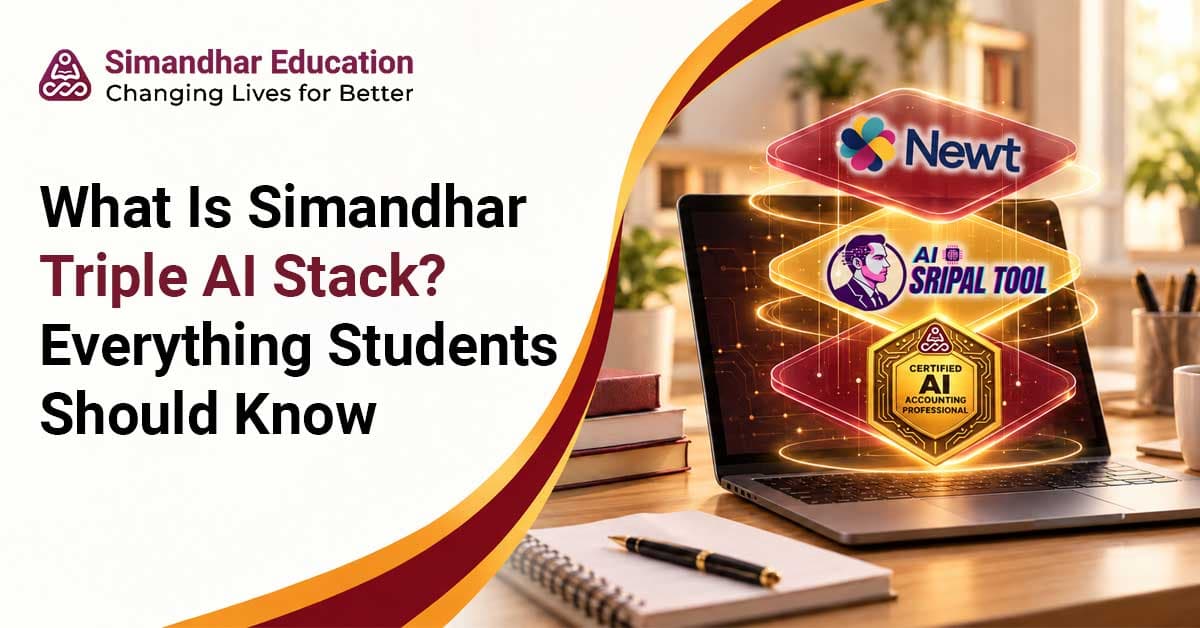
Table of Contents
- 1. What Is Simandhar's Triple-AI Stack? A Plain-English Explainer
- 2. What Is Simandhar's Triple-AI Stack?
- 3. How Does the Simandhar Triple-AI Stack Work?
- 3.1. Becker NEWT AI: AI-Powered Learning for CPA and CMA Preparation
- 3.2. AI Sripal: An AI Mentor for Accounting Students
- 3.3. CAAP: Turning AI Knowledge Into Practical Finance Skills
- 4. Why AI Skills Matter for Finance and Accounting Students
- 5. How Does Triple-AI Help Accounting Students?
- 5.1. Example: A CPA Student Preparing for REG
- 6. A Real Simandhar Example: AI-Assisted Study for a Working Professional
- 7. Another Example: Adaptive Learning During CPA Preparation
- 8. What Does Triple-AI Mean for Working Professionals?
- 9. AI Applications in Accounting: What Could Students Learn to Work With?
- 10. THE MODERN FINANCE SKILL SET
- 11. Is Triple-AI Useful for CPA and CMA Students?
- 12. AI-Enabled Finance Education Is More Than Adding a Chatbot
- 13. The Simple Takeaway
- 14. Frequently Asked Questions
What Is Simandhar's Triple-AI Stack? A Plain-English Explainer
Studying for a finance certification usually means managing three separate challenges: understanding difficult concepts, getting answers when you are stuck, and developing skills that matter beyond the exam. Simandhar's Triple-AI stack brings these three needs into one learning ecosystem through Becker NEWT AI, AI Sripal, and CAAP - covering learning, mentorship, and employability.
That is the basic idea.
But what does Triple-AI actually mean for a CPA or CMA student? And is it useful for someone already working in accounting or finance?
Let's break it down in plain English.
What Is Simandhar's Triple-AI Stack?
The Simandhar Triple-AI stack is a three-part AI-enabled finance education model designed to support different stages of a learner's journey.
Instead of treating AI as one chatbot added to a course, the model separates AI into three roles:
- Becker NEWT AI - AI-powered learning
- AI Sripal - AI-powered mentorship
- CAAP - AI-powered employability and practical finance skills
Simandhar's current Triple-AI programme page describes these three layers covering learning, mentorship, and employability.
Think of it this way:
NEWT helps you learn.
AI Sripal helps you get unstuck.
CAAP helps you build practical AI skills.
Here’s how the three layers work together:
| Triple-AI Layer | Main Question It Addresses | Primary Role |
|---|---|---|
| Becker NEWT AI | “How do I understand and practice this?” | AI-powered learning |
| AI Sripal | “I’m stuck. Where can I get support?” | AI-powered mentorship |
| CAAP | “How can I apply AI in finance?” | Practical AI skills |
That distinction matters because passing an accounting certification and becoming comfortable with AI in finance are not exactly the same thing.
How Does the Simandhar Triple-AI Stack Work?
The three components are designed to address different problems that students and finance professionals commonly face.
1. Becker NEWT AI: AI-Powered Learning for CPA and CMA Preparation
The first layer is Becker NEWT AI, which sits inside the Becker learning ecosystem used for CPA and CMA preparation.
According to Becker, Newt is an AI-powered study assistant that can provide immediate answers, explanations, examples, and follow-up support based on Becker's curriculum. Becker also uses adaptive learning technology to tailor practice toward areas where a learner needs more work.
Simandhar's Triple-AI page positions Becker NEWT AI as its AI-powered learning layer for CPA and CMA students describing it as a system that analyses practice performance and helps identify weaker concepts.
For a student, the practical difference is simple.
Suppose a CPA student repeatedly gets questions on revenue recognition wrong. Instead of continuing to spend equal time on every chapter, AI-assisted learning can help direct attention towards the weaker area.
That does not replace studying.
It makes the study process more targeted.
2. AI Sripal: An AI Mentor for Accounting Students
The second layer is AI Sripal, which Simandhar describes as an AI mentor for accounting certifications.
The tool is positioned as a WhatsApp-based AI support layer covering CPA, CMA, ACCA, CIA, EA and CPE-related questions, with 24/7 availability according to Simandhar's published programme information.
This addresses a different problem from adaptive learning.
Imagine a student studying late in the evening and getting confused about a certification concept. The problem may not be a lack of study material. The problem is that the student has a question right now.
An AI mentor can provide immediate support instead of requiring the learner to wait for the next class or search through multiple resources.
For working professionals, this can be particularly relevant because study time is often fragmented.
A question during a lunch break can be addressed during a lunch break.
3. CAAP: Turning AI Knowledge Into Practical Finance Skills
The third layer is CAAP - Certified AI Accounting Professional.
This is where the Triple-AI concept moves beyond exam preparation.
Simandhar's CAAP programme describes itself as a NASBA Approved programme with two levels and focuses on finance in an AI-driven environment. The programme states that learner's study with industry experts, Microsoft AI practitioners, and leading IIM faculty.
The goal is different from simply asking an AI tool to explain an accounting concept.
CAAP focuses on developing practical AI and finance capabilities that can be applied to professional work.
Simandhar's published Triple-AI page illustrates applications involving tools and areas such as Microsoft Excel, Tableau, Power BI, Microsoft Copilot, ChatGPT, Claude and Gemini, alongside finance-related tasks such as analysis, reporting, forecasting and audit support.
That creates an important distinction:
Learning about AI is not the same as learning to work with AI.
For an accounting student, the second skill can become increasingly relevant as finance teams adopt AI-assisted workflows.
Why AI Skills Matter for Finance and Accounting Students
The demand for AI skills in finance is not limited to education companies.
A 2025 AICPA & CIMA survey of 1,446 finance and accounting professionals found that 88% of finance leaders surveyed viewed AI as a game changer, while only 8% said they felt very well prepared to adopt it. The survey also identified generative AI as the largest skills gap among the areas studied, with 46% of respondents highlighting it as a significant gap for their teams.
The implication is straightforward: knowing accounting remains important, but technology skills are becoming part of the broader finance skill set.
ACCA's 2025 AI Monitor also highlights the need for accountants to build AI-related capabilities while maintaining professional judgement, ethics, and accountability.
This is why AI skills for finance professionals should not mean learning random AI tools without understanding accounting.
The stronger combination is:
Accounting knowledge + professional certification + AI literacy + practical application.
How Does Triple-AI Help Accounting Students?
Consider a B.Com graduate preparing for the US CPA.
Without an integrated AI learning approach, the student may use one platform for exam preparation, search the internet when stuck, and separately look for AI courses after completing the certification.
Triple-AI connects these stages.
Example: A CPA Student Preparing for REG
A student is working through US taxation and regulation concepts.
NEWT AI: supports exam preparation and helps the learner work through difficult concepts and practice.
AI Sripal: provides an additional AI-based support channel when the student has a question about the certification.
CAAP: adds practical AI and finance skills that sit beyond the CPA syllabus.
The student is therefore not looking at AI as a separate subject that comes after accounting.
AI becomes part of the learning journey.
A Real Simandhar Example: AI-Assisted Study for a Working Professional
Simandhar's published student testimonials provide a practical example of how AI support can fit into a working professional's routine.
Sachin Mall, identified by Simandhar as a Fund Accounting Specialist at Citi, described preparing for the CPA while working full-time and specifically mentioned flexible sessions and AI doubt-solving on WhatsApp as part of the support that helped him manage preparation alongside his job.
The useful takeaway is not that AI replaces faculty.
It doesn't.
The value is in reducing friction when a learner needs support outside a scheduled class.
Another Example: Adaptive Learning During CPA Preparation
Simandhar also publishes a testimonial from Khushbu Mittal, identified as an Audit Senior at Deloitte, who attributed her CPA scores to structured study planning and Becker's adaptive learning.
Becker independently describes its Adapt2U technology as a system that uses performance information to create personalized practice and focus attention on weaker areas.
This illustrates where AI-enabled learning can have a practical role: not deciding what a student should become but helping the student identify where more practice is needed.
What Does Triple-AI Mean for Working Professionals?
Triple-AI is not limited to fresh graduates.
A working accountant, auditor, tax professional or finance analyst may already understand accounting principles but still need to improve speed, technology skills and confidence with AI-assisted workflows.
For such professionals, the three layers can be viewed differently:
| NEWT AI | AI Sripal | CAAP |
|---|---|---|
| Supports certification preparation. | Provides accessible study and certification support. | Helps build practical AI capabilities relevant to finance work. |
This matters because professional development is increasingly moving beyond technical qualification alone.
A finance professional may understand financial statements perfectly and still need to know how AI can assist with analysis, reporting, forecasting, documentation, or other routine workflows.
That is where AI for accounting professionals becomes more practical than simply learning about artificial intelligence in theory.
AI Applications in Accounting: What Could Students Learn to Work With?
The practical applications shown in Simandhar's CAAP programme include several familiar finance tools and workflows.
These include:
- Excel for data analysis and finance work
- Power BI for business intelligence and reporting
- Tableau for visualization
- Microsoft Copilot for generative AI-assisted work
- ChatGPT and Claude for AI-assisted analysis and review
- Gemini for multimodal AI applications
Simandhar's programme page demonstrates these tools alongside examples involving financial analysis, dashboards, forecasting, audit review, and business intelligence.
The important point is that practical AI skills for accountants should be connected to real finance tasks.
Knowing the name of an AI tool is not a professional skill.
Knowing where and how to apply it is more useful.
THE MODERN FINANCE SKILL SET
KNOWLEDGE
CERTIFICATION
FINANCE SKILLS
Is Triple-AI Useful for CPA and CMA Students?
For CPA and CMA learners, the three layers address different parts of the preparation journey.
CPA students can use Becker's AI-supported learning ecosystem alongside their exam preparation, while CMA students can also access Becker's Newt AI and adaptive learning capabilities through Becker's CMA review offering.
The third layer, CAAP, then adds an applied AI component beyond the professional exam itself.
That creates a broader learning model:
Professional qualification → AI-assisted preparation → practical AI capability
It does not mean AI guarantees exam success or employment.
Those outcomes still depend on preparation, performance, professional skills, and the requirements of individual employers.
AI-Enabled Finance Education Is More Than Adding a Chatbot
This is perhaps the simplest way to understand the Triple-AI concept.
Adding one chatbot to an accounting course would not automatically create AI-enabled education.
The more meaningful question is: Where does AI actually help the learner?
With Simandhar's model, AI is positioned at three different points:
Learn: Becker NEWT AI supports AI-powered learning and exam preparation.
Ask: AI Sripal provides an AI-based mentorship and doubt-support layer.
Apply: CAAP focuses on practical AI and finance capabilities.
That is the reasoning behind the term Simandhar Triple-AI stack.
The Simple Takeaway
The Simandhar Triple-AI stack is built around a simple idea: finance education should not stop at passing an exam.
NEWT AI helps you learn. AI Sripal helps you get support. CAAP helps you build practical AI skills.
Frequently Asked Questions
1 What is Simandhar's Triple-AI stack?
Simandhar's Triple-AI stack is a three-part AI-enabled learning model built around Becker NEWT AI, AI Sripal and CAAP. The three layers are positioned around learning, mentorship, and employability, respectively.
2 What does Triple-AI mean at Simandhar?
Triple-AI means using three AI-focused layers for different parts of a finance learner's journey: AI-powered learning through Becker NEWT AI, AI-powered mentorship through AI Sripal, and applied AI and finance skills through CAAP.
3 How does Triple-AI help account students?
Triple-AI can support students with AI-assisted exam preparation, quick access to certification-related study support, and practical AI learning for finance. It is designed to complement, not replace, faculty teaching, personal study and professional judgement.
4 Is Triple-AI useful for working professionals?
It can be particularly relevant to working professionals who need flexible study support and want to add AI skills alongside accounting or finance qualifications. Becker provides AI-supported CPA and CMA learning, while CAAP focuses on applied AI skills for finance.
5 Does learning AI mean accountants no longer need accounting skills?
No. AI does not remove the need for accounting knowledge, professional judgement, ethics or accountability. The stronger approach is to combine accounting fundamentals with professional qualifications, AI literacy, and practical finance applications. ACCA also highlights the continuing importance of professional judgement and responsible AI adoption in accountancy.