
Which Is Better: EA or CPA for Tax and Accounting Careers?

Compare EA vs CPA in India. Understand EA or CPA India, EA CPA comparison, tax vs accounting, Big 4 roles, career scope, FAQs, and Simandhar guidance.
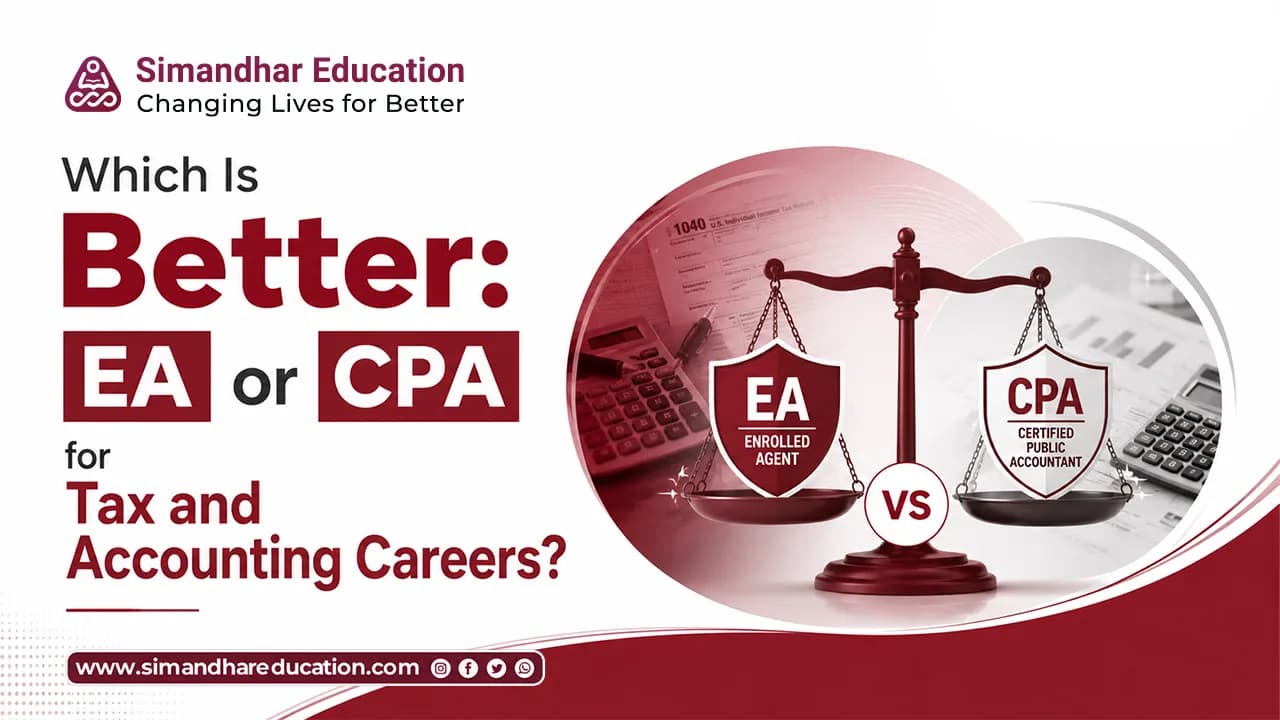
Table of Contents
- 1. What Is EA?
- 2. What Is CPA?
- 3. EA vs CPA: Quick Comparison
- 4. EA or CPA India: Which Should You Choose?
- 5. EA CPA Comparison: Career Focus
- 6. EA vs CPA for Big 4 Jobs
- 7. EA vs CPA for MNC and GCC Roles
- 8. EA vs CPA for Tax Careers
- 9. EA vs CPA Difficulty
- 10. EA vs CPA Salary Scope in India
- 11. Can You Do Both EA and CPA?
- 12. Who Should Choose EA?
- 13. Who Should Choose CPA?
- 14. Common Mistakes Students Should Avoid
- 15. Why Students Choose Simandhar Education for EA
- 15.1. Why students choose Simandhar Education
- 16. Final Thoughts
- 17. Conclusion
- 18. FAQs
- 18.1. EA vs CPA: Which is better in India?
- 18.2. What is the difference between EA and CPA?
- 18.3. EA or CPA India: Which should I choose?
- 18.4. What is EA CPA comparison for Big 4 jobs?
- 18.5. What does tax vs accounting mean here?
- 18.6. Is EA easier than CPA?
Both certifications can build strong careers, but they are designed for different goals. EA is better for students and professionals who want to specialize in U.S. taxation, IRS Representation, tax compliance, and tax advisory roles. CPA is better for those who want broader careers in accounting, audit, taxation, financial reporting, and U.S.-focused finance roles.
For Indian students comparing EA vs CPA, the right choice depends on whether they want a focused U.S. tax career or a broader accounting and finance career.
What Is EA?
EA stands for Enrolled Agent. It is a U.S. federal credential for professionals who want to specialize in U.S. taxation, IRS procedures, tax compliance, and taxpayer representation.
EA is awarded by the Internal Revenue Service (IRS). It is the highest credential the IRS issues, and it allows professionals to represent taxpayers before the IRS in audits, appeals, and collections.
EA is highly relevant for roles in:
- U.S. individual taxation
- U.S. business taxation
- IRS representation
- Tax compliance
- Tax preparation
- Tax advisory
- Tax research
- Taxpayer representation
What Is CPA?
CPA stands for Certified Public Accountant. It is a U.S. accounting credential for professionals who want to build careers in accounting, audit, taxation, financial reporting, and regulatory compliance.
CPA is awarded by state boards and recognized through the AICPA. It is widely valued by Big 4 Firms such as Deloitte, PwC, EY, and KPMG, along with MNCs, GCCs, U.S. accounting firms, and global finance teams.
CPA is suitable for candidates who want roles in:
- Public accounting
- Audit and assurance
- U.S. taxation
- Financial reporting
- Accounting advisory
- Corporate finance
- Compliance
- Global accounting operations
EA vs CPA: Quick Comparison
| Factor | EA | CPA |
|---|---|---|
| Full Form | Enrolled Agent | Certified Public Accountant |
| Focus | U.S. taxation, IRS representation | Accounting, audit, tax, reporting |
| Awarding Authority | IRS | State boards / AICPA |
| Best For | U.S. tax-focused careers | Accounting and U.S. finance careers |
| Exam Structure | 3-part exam pathway | Core sections plus one discipline section |
| Career Direction | Specialized tax route | Broader accounting and finance route |
| Suitable For | Tax professionals, tax practitioners | Accounting, audit, tax, reporting professionals |
| India Career Scope | US tax KPOs, MNCs, GCCs, tax teams | Big 4 audit/tax, MNCs, GCCs, U.S. accounting roles |
EA or CPA India: Which Should You Choose?
The choice between Enrolled Agent vs CPA India depends on your career goal.
Choose EA if you want to work in:
- U.S. individual taxation
- U.S. business taxation
- IRS representation
- Tax Compliance
- Tax preparation
- Tax advisory
- Tax research
- Tax review roles
Choose CPA if you want to work in:
- Accounting
- Audit and assurance
- U.S. taxation
- Financial reporting
- Accounting advisory
- U.S. GAAP-related roles
- Global finance operations
In simple words, EA is more focused on U.S. taxation and IRS representation. CPA is broader and covers accounting, reporting, audit, and taxation.
EA CPA Comparison: Career Focus
The main difference in the EA CPA Comparison is the type of work each certification prepares you for.
EA professionals usually focus on U.S. tax compliance, tax preparation, tax research, and representing clients before the IRS. Their work stays deeply connected to tax laws, filings, and taxpayer issues.
CPA professionals usually work across accounting, audit, tax, reporting, and compliance areas. Their work connects to financial statements, accounting standards, taxation, and regulatory reporting.
This is why the comparison is often understood as tax vs accounting.
EA is stronger for U.S. tax-focused roles. CPA is stronger for accounting, financial reporting, external audit, and broader U.S. finance roles.
EA vs CPA for Big 4 Jobs
Both EA and CPA can help with Big 4 opportunities, but the job roles are different.
Big 4 Firms such as Deloitte, PwC, EY, and KPMG hire EA and CPA candidates across different teams.
| Career Area | Better Fit |
|---|---|
| U.S. tax compliance | EA |
| Tax preparation | EA |
| IRS representation support | EA |
| Tax review | EA |
| Tax advisory support | EA |
| External audit | CPA |
| Financial reporting | CPA |
| Accounting advisory | CPA |
| Assurance | CPA |
| U.S. accounting roles | CPA |
If your goal is a Big 4 U.S. tax delivery role, EA can be a strong choice. If your goal is Big 4 audit, accounting, or financial reporting, CPA can be more suitable.
EA vs CPA for MNC and GCC Roles
MNCs and Global Capability Centers (GCCs) in India need both EA and CPA professionals.
EA professionals are useful for:
- U.S. tax preparation
- Tax compliance support
- Tax return review
- Tax research support
- IRS-related documentation
- Tax workflow processing
CPA professionals are useful for:
- U.S. accounting
- Audit support
- Financial reporting
- Month-end closing
- Reconciliations
- Accounting advisory
- U.S. GAAP reporting
For GCC roles, EA may be better for U.S. tax delivery teams, while CPA may be better for accounting, audit, and financial reporting teams.
EA vs CPA for Tax Careers
Both certifications connect to taxation, but the tax focus is different.
EA focuses entirely on U.S. Taxation. Enrolled Agents handle individual and business tax returns, tax planning, tax compliance, and representation before the IRS. This deep specialization is the biggest strength of the credential.
CPA covers taxation as one part of a broader curriculum. CPA professionals may handle tax work, but they also review financial reporting, accounting, and audit matters.
For tax vs accounting, students should understand this difference clearly:
- EA = deep U.S. taxation and IRS representation
- CPA = accounting, financial reporting, audit, and tax
If you want a pure tax career, EA gives focused expertise. If you want tax along with accounting flexibility, CPA gives broader options.
EA vs CPA Difficulty
EA and CPA are both professional credentials, so both require serious preparation.
EA includes a 3-part exam focused on U.S. taxation. Many candidates find it more focused because it covers one subject area in depth. EA can often be completed within 6 to 9 months.
CPA covers accounting, audit, tax, regulation, financial reporting, and a discipline-based specialization. This broader scope usually makes CPA harder, and it typically takes 12 to 18 months to complete.
In short, EA is more specialized and faster, while CPA is broader and more demanding. The difficulty depends on your background, interest, and preparation style.
EA vs CPA Salary Scope in India
Salary depends on experience, company, city, interview performance, practical exposure, and technical skills.
EA professionals usually grow within U.S. tax KPOs, GCCs, and accounting firms serving U.S. clients. Indicative ranges often look like this:
- Entry level: ₹4.5 – ₹6 LPA
- 2–4 years experience: ₹7 – ₹10 LPA
- Senior / reviewer roles: ₹12 – ₹15 LPA
CPA professionals usually operate at higher complexity, with roles involving review, planning, and team leadership. Indicative ranges often look like this:
- Entry level: ₹6 – ₹8 LPA
- 3–5 years experience: ₹10 – ₹15 LPA
- Manager / specialist roles: ₹18 – ₹25+ LPA
In most cases, CPA offers higher long-term earning potential because of its broader scope and leadership progression. EA, however, delivers faster entry into U.S. tax roles, which makes it a strong short-term ROI option.
Indicative career direction:
| Certification | Common India Roles |
|---|---|
| EA | U.S. Tax Associate, Tax Analyst, Tax Consultant, Tax Reviewer |
| CPA | Audit Associate, U.S. Tax Associate, Financial Reporting Analyst, Accounting Advisory Associate |
Both can support strong salary growth when combined with practical skills and Big 4, MNC, or GCC exposure.
Can You Do Both EA and CPA?
Yes, students and professionals can pursue both if their career goal requires both deep tax expertise and broader accounting knowledge.
Understanding the EA CPA difference can help candidates decide whether pursuing both certifications aligns with their long-term career goals.
EA plus CPA can be a strong combination for roles in:
- U.S. tax advisory
- Tax review and leadership
- Accounting advisory
- Compliance roles
- Global finance teams
- Big 4 tax and assurance teams
Many professionals even start with EA as a faster entry into the U.S. tax ecosystem, then upgrade to CPA for broader career growth. Still, students should not pursue both only to collect certifications. They should first decide their career direction.
Who Should Choose EA?
Choose EA if you are interested in:
- U.S. individual taxation
- U.S. business taxation
- IRS representation
- Tax compliance
- Tax preparation
- Tax research
- Tax advisory
- U.S. tax delivery roles in GCCs and KPOs
EA is suitable for B.Com graduates, M.Com graduates, MBA finance students, CA students, working tax professionals, and anyone who wants a focused U.S. tax career.
Who Should Choose CPA?
Choose CPA if you are interested in:
- Accounting
- External audit
- U.S. Taxation
- Financial reporting
- U.S. GAAP
- Accounting advisory
- Public accounting
- Global finance roles
CPA is suitable for students and professionals who want a broader accounting and U.S.-focused finance career, along with stronger long-term leadership potential.
Common Mistakes Students Should Avoid
Avoid these mistakes while choosing between EA and CPA:
- Choosing EA without understanding U.S. Taxation
- Choosing CPA without understanding accounting and audit
- Comparing only based on salary
- Ignoring eligibility requirements
- Not checking career fit
- Confusing tax-only roles with broader finance roles
- Ignoring Big 4 and GCC role differences
- Not building Excel and communication skills
- Not preparing for interviews
- Choosing based only on popularity
The right choice should match your career goal, not only market hype.
Why Students Choose Simandhar Education for EA
Building a successful career as an Enrolled Agent requires more than passing the SEE exam. It requires practical US taxation knowledge, expert mentorship, and career-focused guidance. As India's leading institute for US CPA and EA training, Simandhar Education helps students prepare for rewarding careers in US taxation, IRS representation, and global accounting.
Why students choose Simandhar Education
- 50,000+ Learners Trained
- 10,000+ Successful Placements
- 250+ Hiring Partners
- 1,000+ Students Placed with ₹10+ LPA Packages
- India's Official Partner for Fast Forward Academy (FFA) – a globally trusted EA learning provider
- Career opportunities with Deloitte, EY, KPMG, PwC, BDO, RSM, Grant Thornton, and leading US CPA firms
- Expert faculty with practical US taxation and IRS representation experience
- AI-powered learning support through AI Sripal
- Live Interactive Classes, Recorded Sessions, and One-to-One Mentorship
- Resume Building, Interview Preparation, and Placement Assistance for US Tax, Big 4, GCC, and US CPA firm roles
- End-to-End Support from enrolment to career placement
Whether your goal is to become an IRS Enrolled Agent, work with a Big 4 firm, or build a career in US taxation and compliance, Simandhar Education provides the expertise, mentorship, and placement support to help you succeed in the global tax profession.
Final Thoughts
EA and CPA are both valuable, but they are built for different career paths.
Choose EA if your goal is U.S. taxation, IRS representation, tax compliance, and tax advisory.
Choose CPA if your goal is accounting, audit, taxation, financial reporting, and broader U.S.-focused finance roles.
For Indian students, the best choice depends on whether they want a focused U.S. tax career or a broader accounting and finance pathway.
Conclusion
Confused between EA and CPA?
Book a free counselling session with Simandhar Education and get expert guidance on EA, CPA, Big 4 roles, MNC opportunities, eligibility, preparation strategy, and your complete global finance career roadmap. Talk to an Expert +91 7780273388
FAQs
1. EA vs CPA: Which is better in India?
EA vs CPA depends on your goal. EA is better for U.S. taxation, IRS representation, and tax-focused careers. CPA is better for accounting, audit, taxation, and financial reporting.
2. What is the difference between EA and CPA?
EA focuses on U.S. Taxation and IRS representation. CPA focuses on accounting, taxation, audit, and financial reporting across a broader curriculum.
3. EA or CPA India: Which should I choose?
Choose EA or CPA India based on your career interest. Choose EA for U.S. tax and IRS representation roles. Choose CPA for accounting, reporting, audit, and broader finance roles.
4. What is EA CPA comparison for Big 4 jobs?
In the EA CPA comparison, EA fits Big 4 U.S. tax delivery teams, while CPA fits Big 4 audit, accounting advisory, and financial reporting teams.
5. What does tax vs accounting mean here?
Tax vs accounting means EA is focused on U.S. taxation and IRS Representation, while CPA is focused on accounting, financial reporting, audit, and tax.
6. Is EA easier than CPA?
EA is more specialized and usually faster to complete, while CPA is broader and more demanding. Difficulty depends on your background and career interest.